
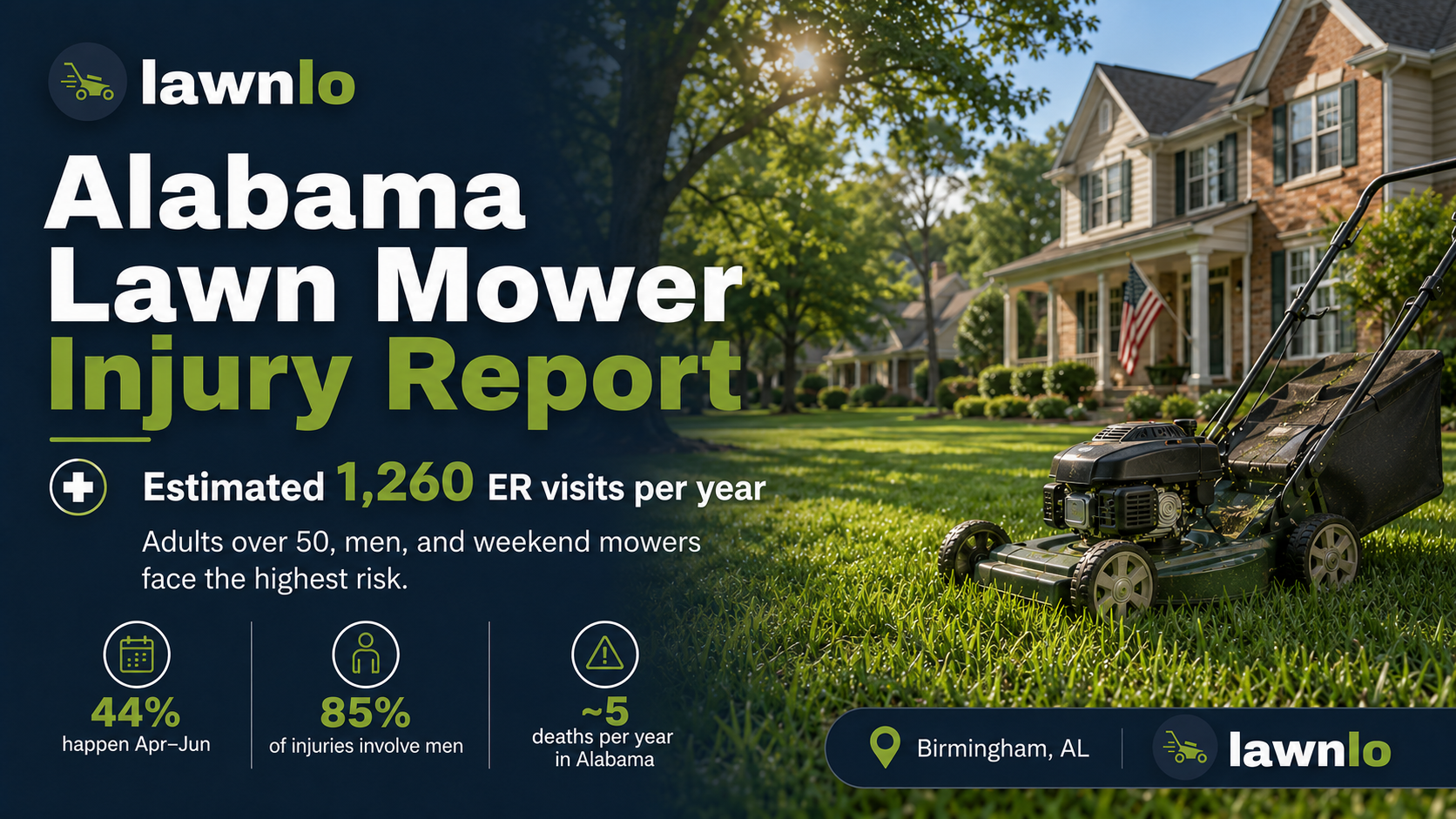

An estimated 1,260 Alabamians will visit an emergency room this year with a lawn mower injury. Roughly five of them will die. And more than 40% of those injuries will happen in a three-month window that just started.
Those are the findings from a new analysis by lawnlo, a Birmingham-based lawn service, that combined federal injury surveillance data from the U.S. Consumer Product Safety Commission (CPSC), Centers for Disease Control and Prevention (CDC), and the Alabama Department of Public Health to estimate the true statewide scope of lawn mower–related emergency care.
The picture that emerges is at odds with how most homeowners think about lawn care. Lawn mower injuries are not rare. They are not confined to children. They are not a curiosity of a few careless accidents. In Alabama, they represent a persistent, multi-million-dollar public health problem that arrives every summer and disproportionately harms adults over 50, men, and residents of the American South — the region with the highest lawn mower injury rate in the country.
Key findings — Alabama lawn mower injury report
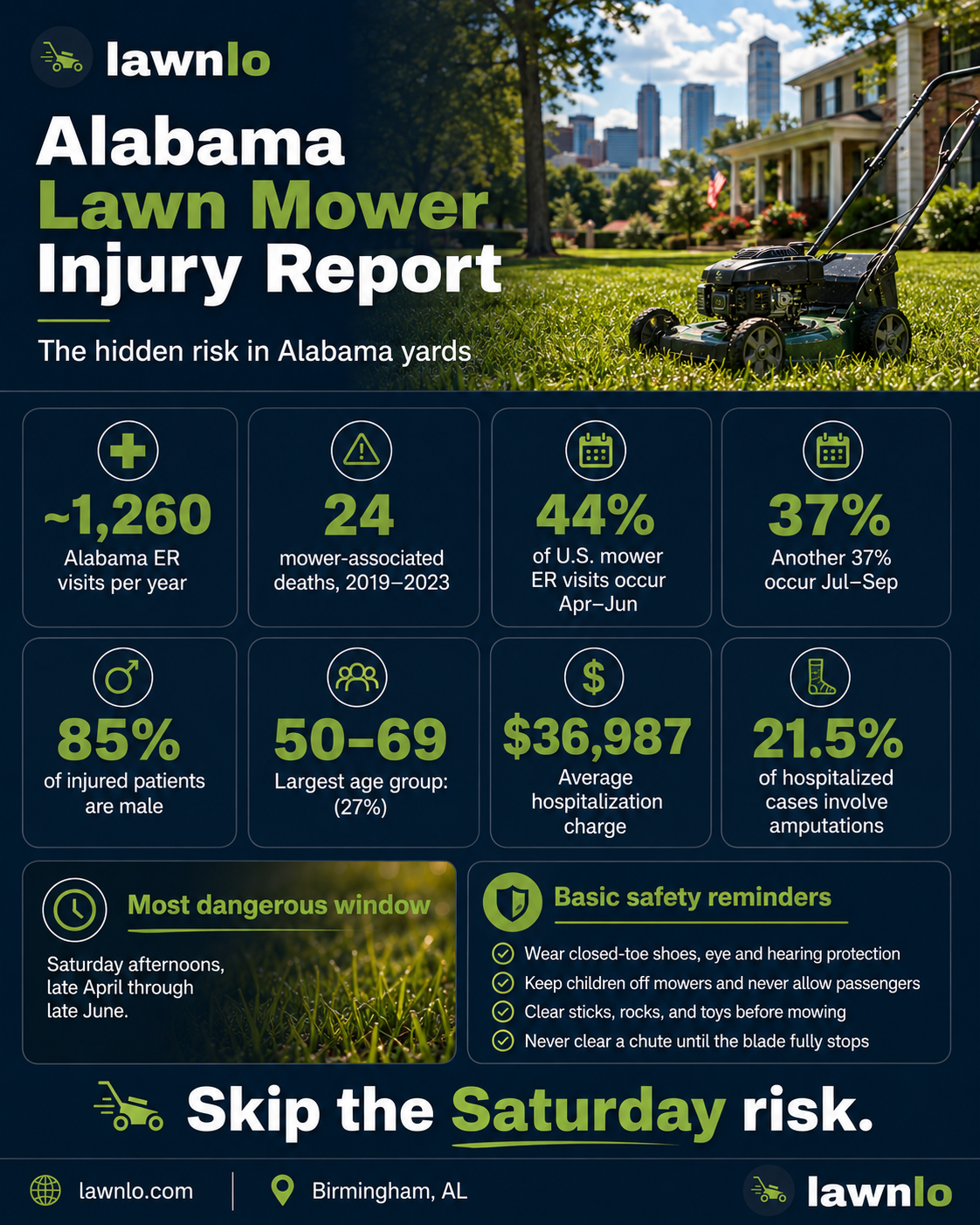
- ~1,260 estimated Alabama emergency room visits per year from lawn mower injuries
- 24 deaths associated with lawn mowers in Alabama between 2019 and 2023 (Alabama Department of Public Health)
- 44% of all US lawn mower ER visits occur April–June; another 37% July–September
- 85% of injured patients are male; the largest age group is 50–69 years old (27% of all injuries)
- $36,987 — average hospitalization charge per admitted patient
- 21.5% of hospitalized cases involve amputations, primarily of hands or feet

Alabama sits in the deadliest US region for lawn mower injuries
Nationally, about 84,944 lawn mower injuries are treated in US emergency departments each year, according to a peer-reviewed analysis of the CPSC’s National Electronic Injury Surveillance System (NEISS). Roughly 75 people die annually in riding-mower incidents alone.
Those injuries are not evenly distributed. The American South accounts for 37.5% of all US lawn mower injuries — more than any other census region and nearly double the West’s share (11.8%). Alabama, with its long growing season, high homeowner-mowing rate, and warm-season turfgrasses that require weekly cutting from April through October, sits squarely within that danger zone.
Extrapolating the regional injury share to Alabama’s population of roughly 5.1 million — approximately 4% of the South’s total — yields an estimated 1,260 lawn mower ER visits per year in the state. At the CDC-published mean emergency department charge of $2,482 per visit, that is nearly $3.1 million in ED billing alone. Adding the roughly 20% of injuries that require inpatient admission at an average of $36,987 pushes Alabama’s estimated annual medical cost from lawn mower injuries to $8 to $10 million.
The Alabama Department of Public Health reported 24 lawn mower–associated deaths in the state between 2019 and 2023, or roughly five per year. The agency notes that these deaths were “associated with (or involved) a lawn mower” — a category that includes both direct operational injuries and secondary events such as heart attacks or heat stroke during operation.
The typical Alabama lawn mower injury is not what you think
Public messaging around lawn mower safety has focused heavily on children — for good reason, given that riding-mower injuries are the leading cause of major limb loss in young US children. Nationally, more than 9,400 children under 18 are treated in emergency rooms each year for lawn mower–related injuries, with an average injured-child age of just 7.5 years. One in four pediatric injuries occurs to a child under six.
But the child-focused framing misses the largest population at risk. According to the CDC/NEISS analysis, the 50-to-69 age bracket accounts for 27.2% of all lawn mower injuries — more than any other age group and more than four times the pediatric share. Men make up 85.2% of the injured across all ages.
The typical injury sends a patient home with a laceration or fracture, not an amputation. Lacerations account for 46.7% of cases, followed by fractures (22.4%) and amputations (21.5%). The most common injury sites are the hand and wrist (65.4%) and the foot and toes (19.8%) — the appendages nearest to blades, discharge chutes, and unbalanced mowers on slopes.
The dangerous window: weekends, April through September
Lawn mower injuries follow a strikingly predictable calendar. Nationally, 44.4% of all ED-treated lawn mower injuries occur in April, May, and June, when homeowners resume mowing after the winter dormancy period and rush to catch up with fast-growing spring turf. Another 37.3% occur in July, August, and September — the peak of Alabama’s mowing season. Only 6.8% happen in January through March.
Within any given week, weekends carry the highest risk: 33.7% of injuries happen on Saturday or Sunday. That is roughly double the daily average, reflecting the disproportionate share of homeowner mowing that happens on days off rather than during weekday professional service visits.
Combined, the data suggests the single most dangerous window of the Alabama lawn year is a Saturday afternoon between late April and late June, when the ground is often damp from spring rain, blades are dulled after winter storage, and a homeowner is attempting to clear an overgrown yard in a single session.
What state health officials recommend
Dr. Scott Harris, Alabama’s State Health Officer, issued a July 2025 advisory calling attention to lawn mower–related injuries as an ongoing preventable-harm category.
“Lawn mowers are powerful machines and must be used properly to prevent what could be life-changing injuries.”
— Scott Harris, M.D., M.P.H., State Health Officer, Alabama Department of Public Health
The Alabama Department of Public Health’s core safety recommendations, echoed by the American Academy of Pediatrics and the CPSC, include:
- Minimum operator ages: No child under 12 should operate a walk-behind mower; no child under 16 should operate a ride-on mower.
- No child passengers on ride-on mowers — ever. Even brief rides account for a documented share of pediatric amputation cases.
- Protective gear: Sturdy closed-toe shoes, eye protection, and hearing protection for every mowing session.
- Clear the lawn of sticks, rocks, and toys before starting — projectile injuries account for a meaningful share of ED visits.
- Never bypass the deadman switch — the automatic shut-off engineered to stop blades when the handle is released.
- Wait for full blade stop before clearing a clogged chute, adjusting height, or performing any maintenance.
- Refuel outdoors only, with the motor off and cool. Do not refuel a hot engine.
- Avoid mowing wet grass or slopes, particularly with a rider — most rollover fatalities occur on slopes greater than 15 degrees.
The professional service alternative
The CPSC does not track injury rates for professional lawn service technicians separately, but occupational safety data suggests professional operators — who use commercial equipment with more consistent guarding, mow the same lawns weekly, and are trained in slope and slip management — sustain a small fraction of the per-hour injury rate of homeowner operators. The clearest way for an Alabama homeowner to reduce personal lawn mower injury risk to zero is to not personally operate a lawn mower at all.
That is not a viable option for every household — but for the 1,260 Alabamians projected to visit an emergency room this year for a lawn mower injury, and the roughly $9 million in medical costs the state’s population will collectively bear, professional weekly service represents one of the most reliable prevention interventions on the market.
Skip the Saturday risk.
lawnlo handles weekly lawn mowing across the Birmingham metro — Hoover, Vestavia Hills, Homewood, Mountain Brook, Pelham, and more. Vetted local pros, satellite-measured pricing, no contracts.
Methodology and data sources
This analysis was prepared by lawnlo using publicly available injury surveillance data. Alabama-specific mortality figures are drawn from the Alabama Department of Public Health’s July 2025 State Health Officer advisory, which reported approximately 24 lawn mower–associated deaths in the state between 2019 and 2023.
National and regional injury figures are drawn from a peer-reviewed analysis of the U.S. Consumer Product Safety Commission’s National Electronic Injury Surveillance System (NEISS), which weights a probability sample of approximately 100 US emergency departments to produce national estimates (Bortolin M. et al., published in Public Health Reports, PMC6134564). Additional injury-type and pediatric figures are drawn from a 2005–2015 review published in the Journal of Emergency Medicine (PMID 29395756).
Alabama-specific ER visit estimates were derived by applying the peer-reviewed South-region share of national lawn mower ED visits (37.5%) to Alabama’s proportional share of the South’s population (approximately 4.0% based on 2024 US Census Bureau estimates). Estimated medical cost was computed by combining the mean CDC-published ED charge of $2,482 with the mean inpatient charge of $36,987 for the roughly 20% of injuries requiring admission. Figures should be treated as approximations; direct Alabama-only NEISS extracts are not published.
Journalists and researchers seeking additional detail or the underlying data package may contact lawnlo at press@lawnlo.com.
Related guides from lawnlo
- Best Time of Day to Mow in Birmingham Summer Heat
- How Often Should You Mow Your Lawn in Alabama?
- Birmingham Lawn Care Schedule 2026
- The Alabama Lawn Care Bible
About lawnlo
lawnlo is a Birmingham, Alabama–based lawn service that provides weekly mowing to homeowners across the Birmingham metro and Gibson County, Tennessee, using satellite-measured pricing and vetted local operators. Founded in 2021, lawnlo publishes original service journalism on Alabama lawn care topics at lawnlo.com/articles.